Your documents read, checked and decided, on your servers
Repody extracts every field from your invoices, statements and contracts in a single pass, applies your business rules and tells you what to review. You run it yourself, under your own brand.
Perpetual licence · On-premise or private cloud · French and English
- Queued
- GPU waking up
- Extract · Invoice
- Check 2 rules
- Save the report
- pass from the document image to typed fields
- 1
- field types, from dates to IBANs and tables
- 24
- A4 pages read in a single pass
- 40
- bytes of your documents leaving your network
- 0
[01]
From a pile of documents to a verdict
A workflow describes what you receive and what must be true. Repody does the rest, document after document.
- 1
Describe the documents
Name each document you receive and the fields to read from it: exact text, amounts, dates, IBANs, lists, tables.
- 2
Write the rules
Compare fields, do arithmetic, cross-check two documents. Each rule rejects or flags.
- 3
Send the files
From the interface to test, from your systems through the API with the workflow's key.
- 4
Read the verdict
Passed, needs review or rejected, with every extracted value and the failing rule beside it.
[02]
Repody in two minutes
[03]
One pass instead of three
Classic pipelines turn the document into text, then Markdown, then ask a large model to guess. Every step loses information and adds time.
Classic pipeline
- OCR
- Markdown
- Large language model
- Three calls to pay for one document
- Layout and checkboxes get lost
- The model patches OCR errors without seeing the page
- Latencies add up
Repody
- Page image
- Repody VLM
- Typed fields
- A specialised model reads the page image directly
- Output constrained by your schema: valid, typed JSON
- Tables, nested objects and lists understood as they are
- One call per document, several documents in parallel
[04]
What your teams use every day
A dense, calm interface built for operators who review hundreds of documents.
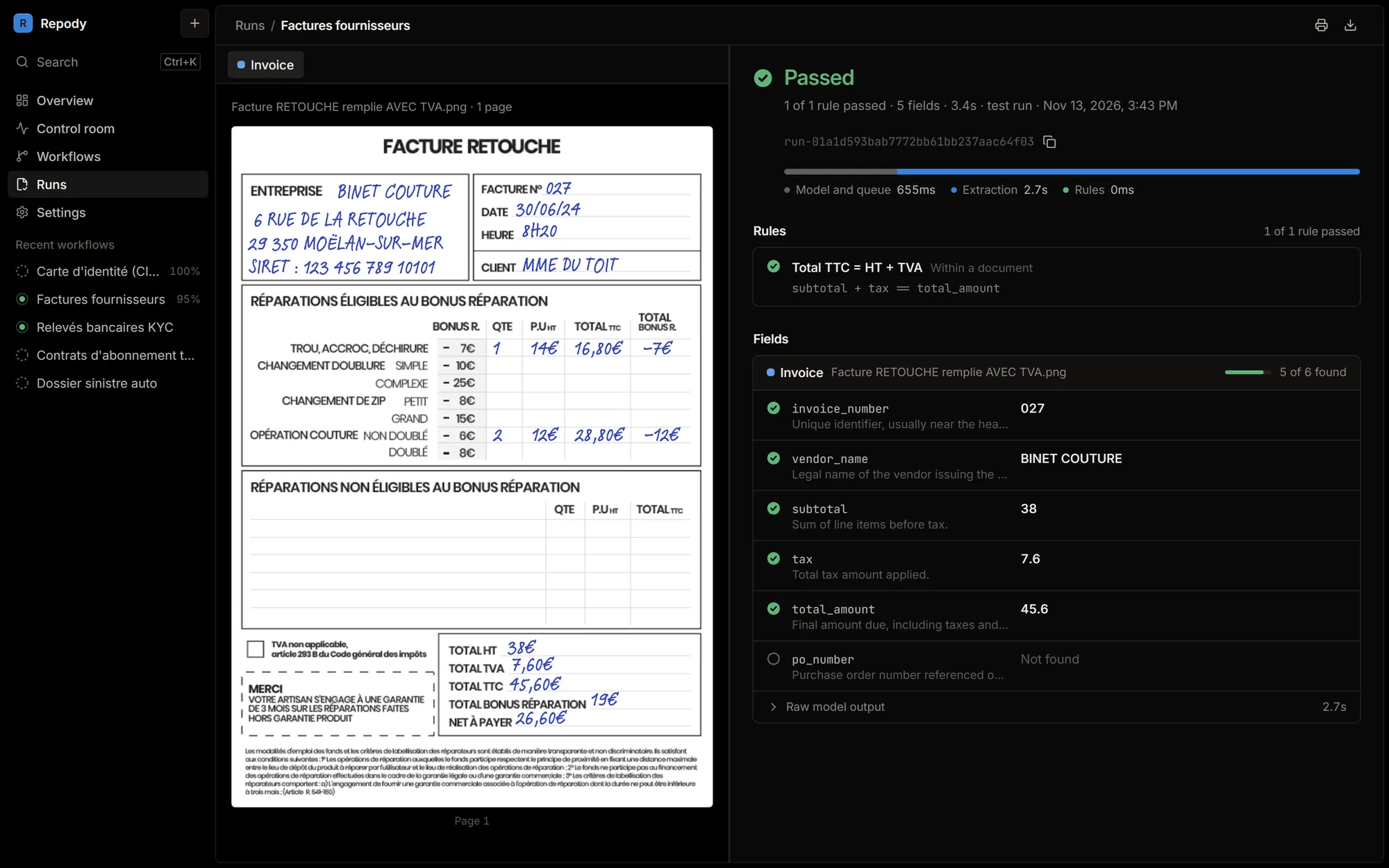
A report for every run
Every field on its own line with its status mark, the failing rule written beside it, the model's raw output one click away.
Learn more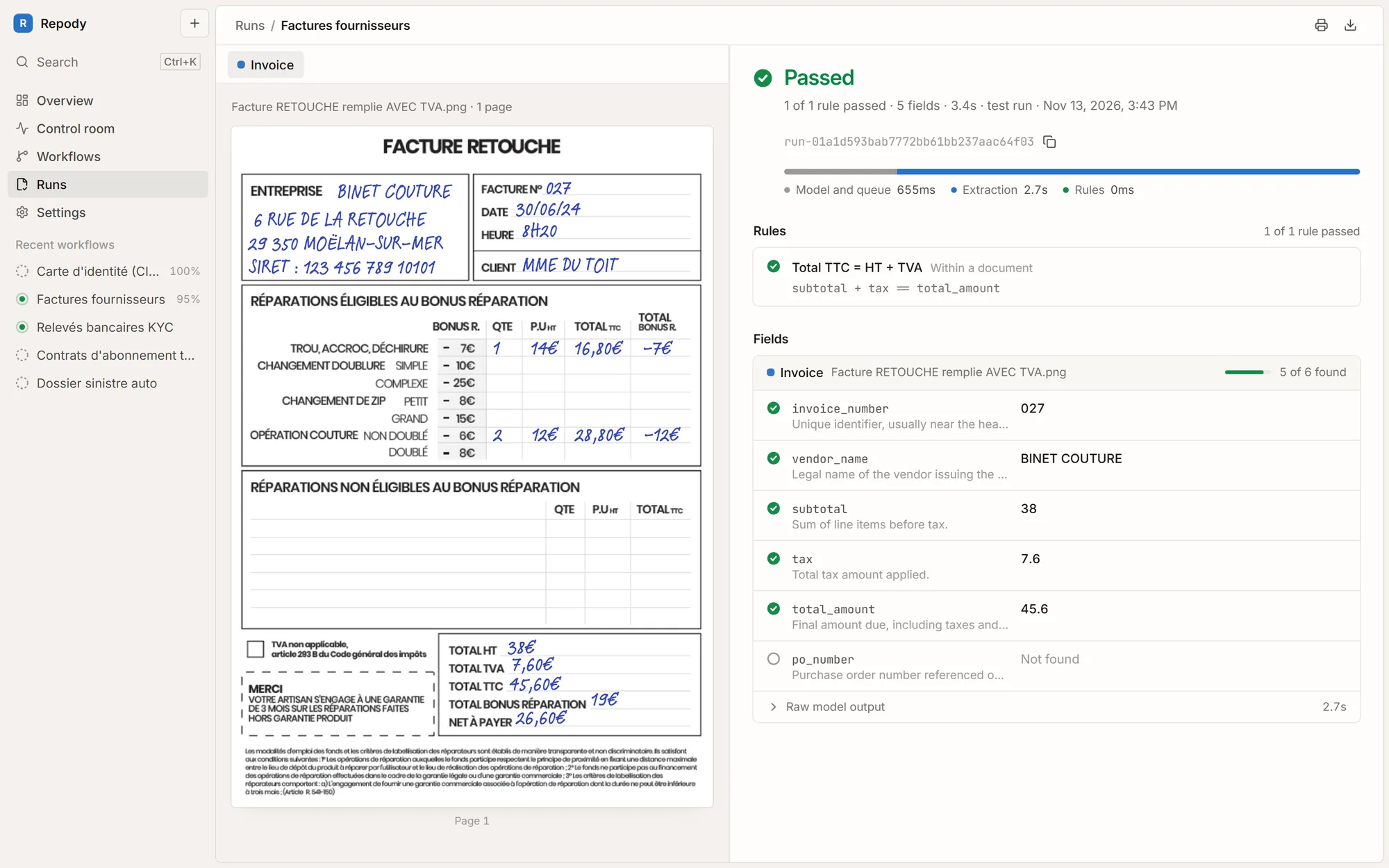
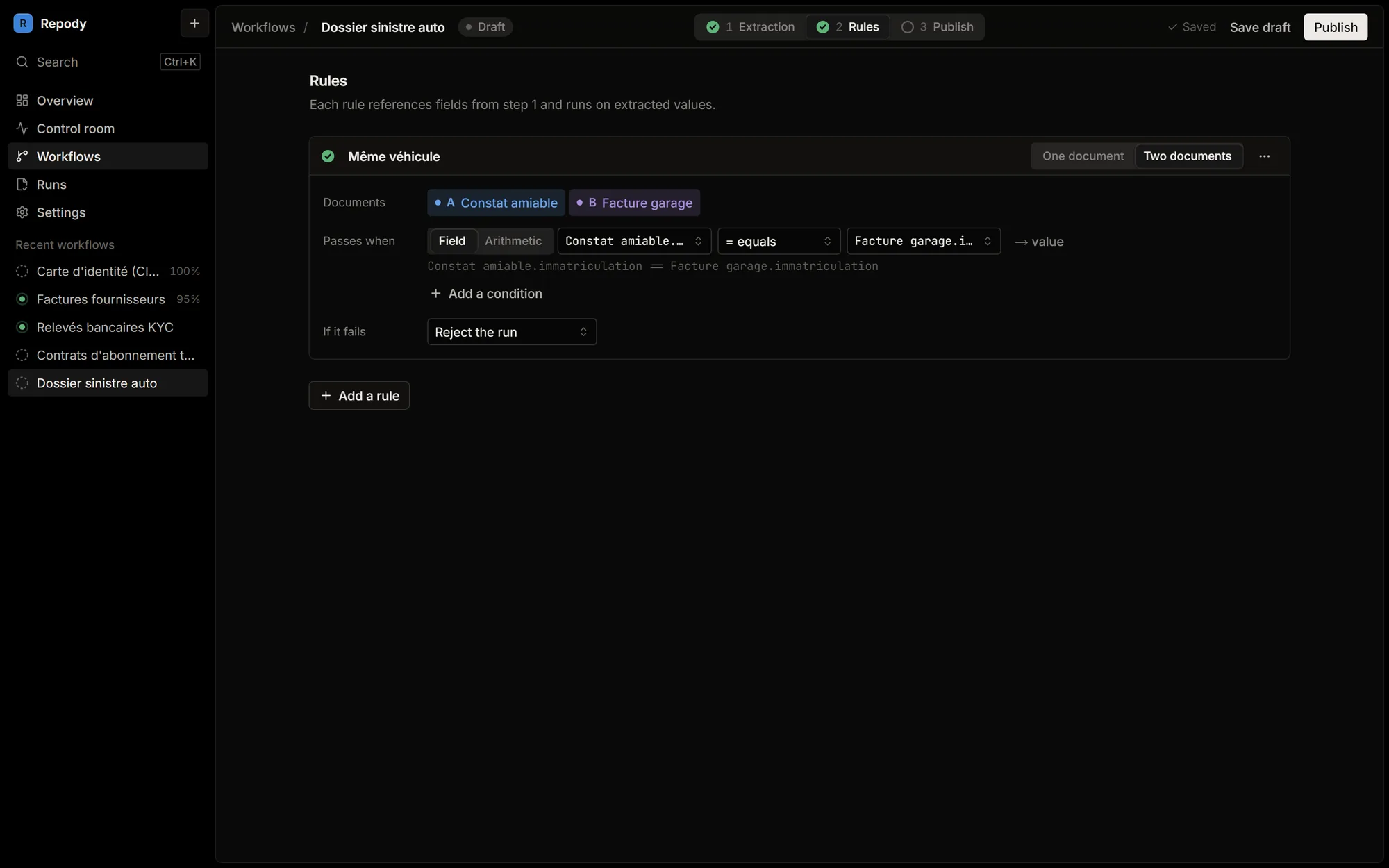
A no-code workflow builder
Documents, fields and rules read like sentences. Rules are checked while you write them.
Learn more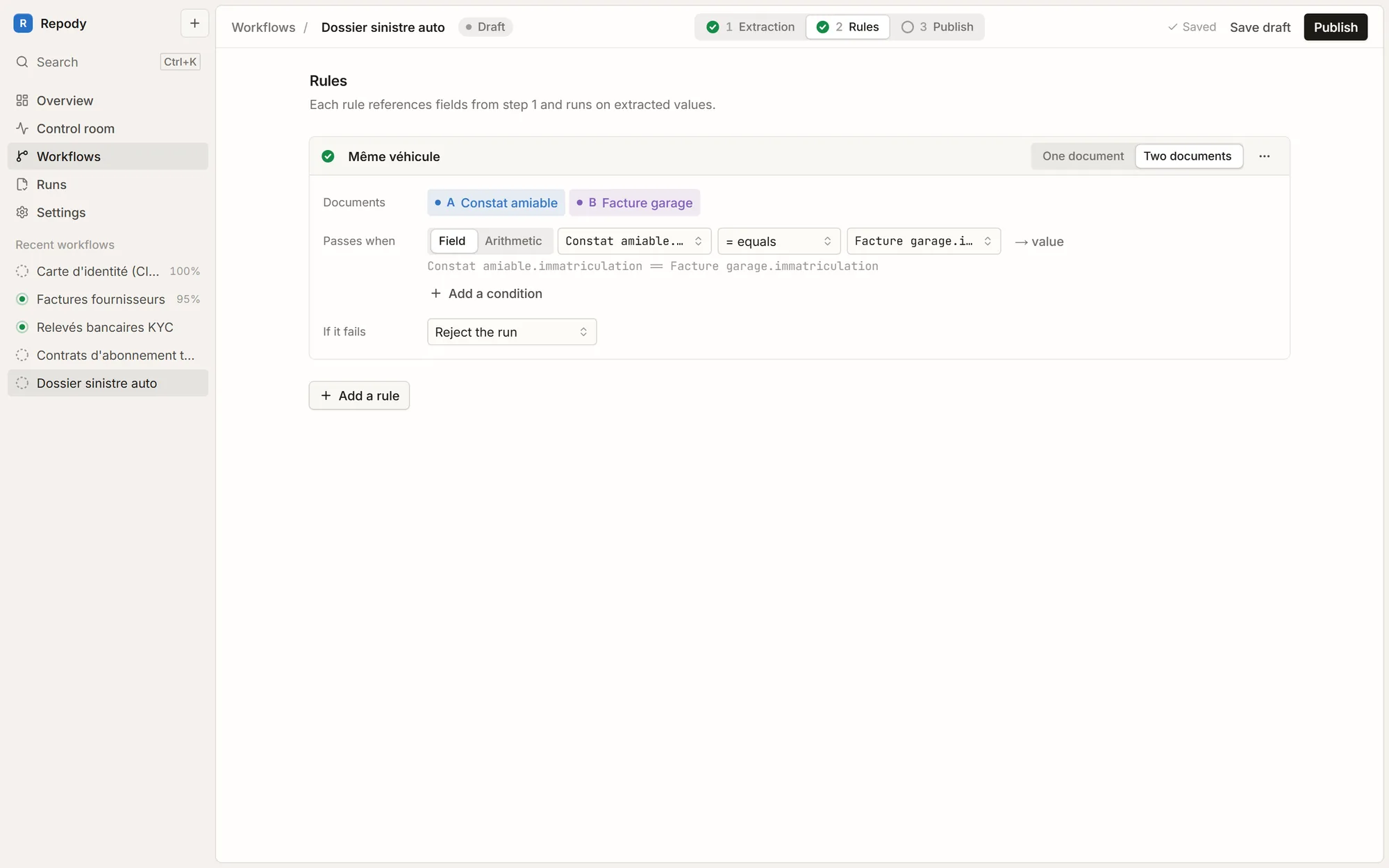
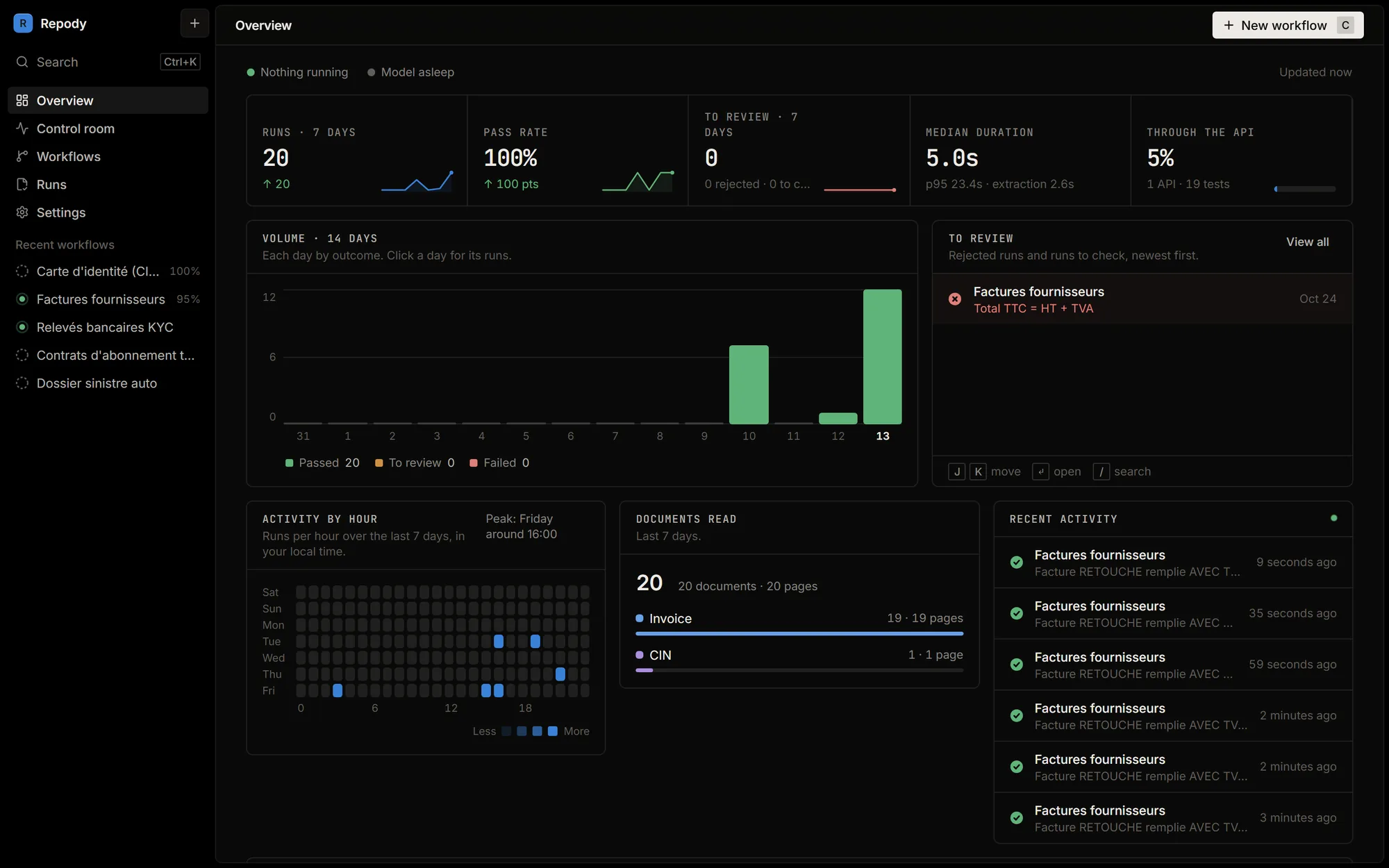
An overview that starts with what matters
What to review first, then the week's volume and pass rate.
Learn more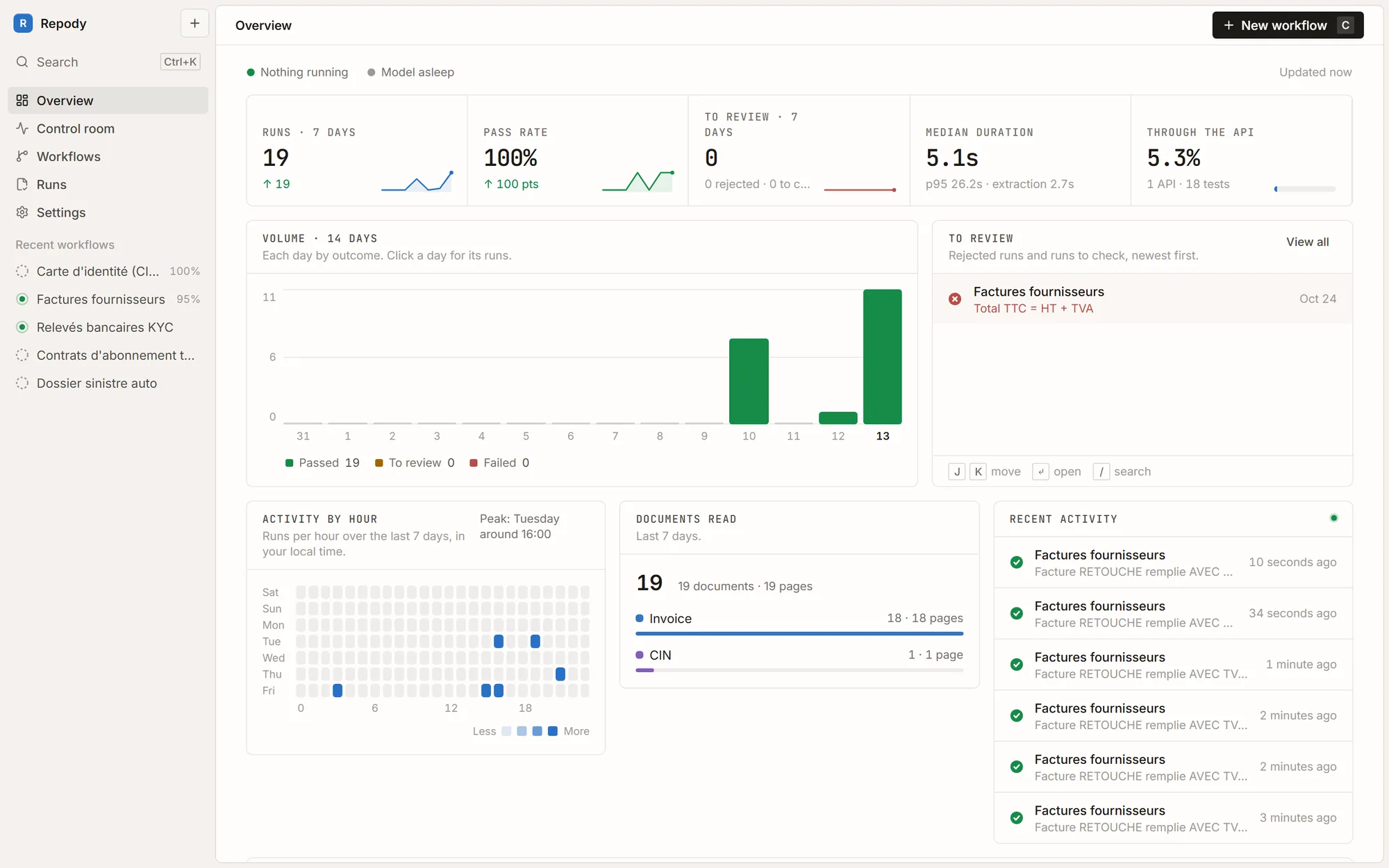
[05]
Your brand, not ours
Name, logo, base colour, accent colour, contrast and corner radius: six settings, and the whole interface re-themes, light and dark. Text contrast is guaranteed by the engine whatever colour you pick.
[06]
Secure and sovereign by design
Repody is built for regulated environments: your documents never leave your infrastructure, and every access goes through your identity provider.
Your data stays with you
Database, storage and model run inside your network. Nothing is sent to a third party.
Your SSO, your roles
OpenID Connect with Keycloak, PKCE, two-factor authentication for administrators, every sign-in kept 90 days, and four roles with precise permissions.
Protected API keys
One key per workflow, shown once, stored as a SHA-256 hash and compared in constant time.
Hardened containers
Non-root users, read-only file systems, no privilege escalation, capped memory.
Signed, verified images
SBOM, provenance and a Sigstore signature on every release; the signature is verified before every deploy.
No open ports
Public traffic arrives through an outbound tunnel, administration through an identity-checked private network.
[07]
Installed where your data must stay
The same product, three ways to run it.
One server
Docker Compose on a Linux machine: the whole stack with its logs, error tracking and encrypted nightly backups, deployed automatically after a staging copy.
Kubernetes or OpenShift
A Helm chart with autoscaling, disruption budgets and network policies.
Your GPU or a managed GPU
The model runs on your graphics card or on a serverless GPU that switches off when idle.
[08]
Built like critical infrastructure
Every change goes through a chain of checks before it reaches a server. A release ships only when every one of them is green.
- Lint and format01
- Type checks02
- Architecture contracts03
- Tests on PostgreSQL04
- API contract05
- Dead code06
- Build07
- Full stack boots08
- Vulnerability scan09
- SBOM and provenance10
- Signing11
- Staging and a real run12
- The same images promoted13
[09]
Built for industries that run on documents
Banking
Account opening, lending, compliance.
- Bank statements
- Proof of income
- Bank details (RIB)
- Pro forma invoices
Insurance
Underwriting and claims handling.
- Accident reports
- Garage quotes and invoices
- Expert reports
- Certificates
Telecom
Business subscriptions, purchasing, compliance.
- Subscription contracts
- Purchase orders
- Supplier invoices
- Company documents
[10]
Frequently asked questions
Where are our documents stored?
On your servers. Repody installs in your infrastructure (one server or a Kubernetes cluster) with its PostgreSQL database, S3-compatible object storage and model server. No document is sent to a third-party service.
Do we need a GPU?
The extraction model runs best on a 24 GB GPU (NVIDIA L4 or A10). Use your own, or a serverless GPU that only costs while runs are processing and starts in a few seconds.
Which documents and languages?
PDF, PNG, JPEG and WebP, 20 files per run. A document is read in a single pass, up to about 40 A4 pages; a longer one is refused at once, with the reason, before anything is charged. The model reads French, English and the main European languages; the interface is in French and English.
What accuracy should we expect?
It depends on your documents. We measure it with you during a pilot, on your own files and rules, before any decision.
Can we resell Repody under our brand?
Yes. Name, logo and colours are set per deployment, without changing code. The licence covers white-label use.
How do we integrate it?
Through a REST API: one call sends the files and returns a run id, a second reads the result. cURL, Python and JavaScript examples are generated in the interface for every workflow.
Who can see what?
Access goes through your identity provider. Four roles (viewer, operator, admin, platform admin) grant precise permissions on workflows and runs.
What happens if a server fails during a run?
The run recovers by itself: a worker that stops hands it to another, a database restart is retried, and it is charged once. Every database and every document is backed up, encrypted, each night to object storage, and restoring is tested.
Can we offer Repody to our own clients?
Yes. One installation serves several client companies, each seeing only its own work. You invite their users, grant them credits (one per page read) and follow their usage and the GPU cost from the admin area.
How do updates work?
Every release is built once, scanned, signed and run on a staging copy with a real document before it reaches production. You choose the version to deploy; its signature is verified before installation, and rolling back is the same command.
See Repody on your own documents
A 30-minute demo, then a pilot on your files and your rules.